


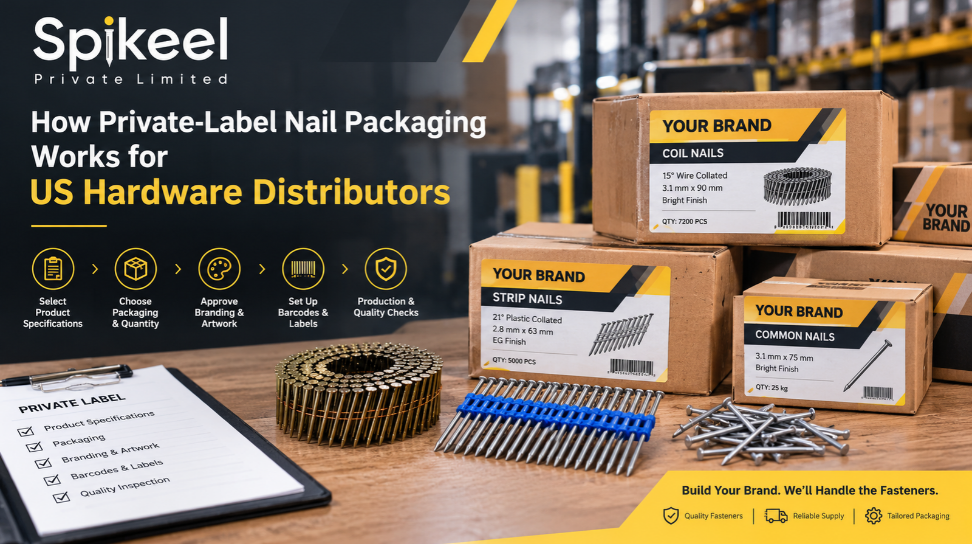
Private-label nail packaging allows hardware distributors and fastener wholesalers to sell nails under their own brand rather than the manufacturer’s brand. The process typically involves selecting the right nail specifications, agreeing on packaging quantities, preparing branded artwork, defining product and carton labels, inspecting the finished goods, and approving the packaging before production.
For US distributors, private labeling can help build brand recognition, differentiate product lines, and maintain a consistent presentation across retail, contractor, and industrial sales channels. However, success depends on more than printing a logo on a box. Nail compatibility, material and finish details, accurate labeling, packaging durability, inventory planning, and quality verification must all work together.
Spikeel Pvt Ltd, a fastener manufacturer based in Bangalore, Karnataka, India, lists wire-collated coil nails, plastic-collated strip nails, and bulk nails among its products. Its website also describes private-label and packaging options for bulk nails. Distributors should confirm the availability, scope, and commercial terms of any specific private-label program directly with the company.
What Is Private-Label Nail Packaging?
Private-label nail packaging is a supply arrangement in which a distributor or brand owner markets nails under its own brand, using packaging designed for its business. The underlying product is manufactured by a third-party supplier, while the distributor controls or approves the branding and product presentation.
Depending on the agreement, the arrangement may include:
A distributor’s logo, brand colors, and product naming.
Nail specifications and packaging quantities selected for individual product lines.
Branded boxes, labels, cartons, or bulk containers.
Product identification, barcode, and inventory information.
Agreed inspection, documentation, and packaging approval procedures.
Not every arrangement includes all these services. The exact scope depends on the manufacturer’s capabilities, order requirements, packaging design, and commercial agreement.
For a hardware distributor, the goal is to create packaging that accurately represents the product, makes stock easier to identify, and gives customers confidence in what they are purchasing.
How Does the Private-Label Nail Packaging Process Work?
A successful program usually follows a defined sequence. Agreeing on product specifications before designing packaging helps prevent incorrect labels, mismatched stock, and avoidable rework.
Step 1: Select the nail type and specifications
Start by defining the products that will carry your brand. Spikeel lists several relevant categories, including 15-degree wire-collated coil nails, 21-degree plastic-collated strip nails, and bulk nails.
Your product specification should identify the following wherever applicable:
Nail length and diameter.
Head type and shank profile.
Point configuration.
Collation type and angle.
Steel grade or material requirements.
Surface finish or corrosion-protection coating.
Intended application and relevant performance requirements.
For example, a coil nail designed for a compatible pneumatic coil nailer should not be described or packaged as interchangeable with a plastic-collated strip nail. Collation format and angle influence tool compatibility.
Confirm the specifications against the actual product and the intended application before artwork is finalized. For construction or other demanding applications, check project requirements, applicable codes, and tool-manufacturer instructions.
Step 2: Define the packaging format and pack quantity
The next step is to decide how customers will buy, handle, store, and resell the product.
Packaging formatTypical considerationRetail or shelf-ready boxBrand visibility, product identification, and shelf presentationContractor-oriented boxClear specifications and convenient handling on jobsitesWholesale inner cartonPack quantity, internal identification, and efficient stock managementOuter shipping cartonProtection during handling and identification of the carton contentsBulk container or drumContainment, handling requirements, and clear identification of loose nails
The most suitable format depends on the nail type, quantity, distribution channel, and handling conditions. A box designed for loose bulk nails may not suit collated nails that need to remain organized and protected.
Define the quantity per pack, packs per case, gross and net weight where relevant, and outer-carton configuration. Confirm which packaging formats Spikeel can supply for the selected product and order volume.
Step 3: Develop the private-label artwork
Once the product and packaging format are established, prepare the branding and label artwork.
Common packaging elements include:
Brand logo and product family name.
Product description and SKU.
Nail dimensions and collation type.
Material and finish information.
Quantity per package.
Manufacturer or supplier identification, as agreed.
Barcode and other inventory identifiers, where required.
Handling or application information when appropriate.
Keep the layout readable. A logo should establish brand identity, but essential technical details must remain easy to locate.
Avoid vague descriptions such as “premium nails” when buyers need a specific diameter, length, or finish to select the correct product. Likewise, do not use claims such as “rustproof,” “structural grade,” or “code compliant” unless the wording is supported by the actual product specifications and relevant evidence.
Before printing, have the distributor and supplier approve the artwork against a master product specification. This review should include spelling, dimensions, pack quantity, barcode data, finish descriptions, and any country-of-origin or manufacturer information required for the intended market.
Step 4: Establish barcode and carton-label requirements
Barcodes connect the physical product with the distributor’s inventory, ordering, and point-of-sale systems. The correct identifier depends on the product’s selling unit and the requirements of the distributor’s customers.
A UPC barcode may be needed for a retail unit, while wholesale cases may require a different identifier or barcode configuration. Do not assume one barcode works for every packaging level.
GS1 explains that the brand owner is normally responsible for assigning a Global Trade Item Number (GTIN) to its trade items, subject to applicable exceptions. Distributors should coordinate identifiers with their GS1 organization and customers rather than inventing or reusing numbers.
For each SKU, establish:
The approved product identifier and barcode.
The correct quantity associated with that identifier.
The distinction between individual packs and outer cases.
Label placement and print readability.
Lot or batch identification, where applicable.
Any customer-specific warehouse or receiving requirements.
Test barcode readability on the actual packaging material before approving a large production run. Confirm retailer, wholesaler, and warehouse requirements in advance.
Step 5: Align production, packaging, and quality checks
Private-label packaging should be tied to a defined product specification. Otherwise, the correct branding could be applied to an incorrect size, finish, or collation format.
Spikeel’s published quality assurance information describes raw-material inspection, work-in-process inspection, dimensional analysis, testing, traceability, and pre-dispatch inspection. It also lists tests such as wire tensile strength, nail bend yield moment, withdrawal, ductility, salt-spray analysis, and coating-weight analysis.
For a private-label order, discuss which checks and records are applicable to the product being purchased. Agree on acceptance criteria before production.
The inspection plan may address:
Nail dimensions and visual condition.
Correct material and surface finish.
Collation quality and feeding-related consistency, where relevant.
Correct count or weight per package.
Packaging integrity and label accuracy.
Lot identification and agreed inspection documentation.
These checks should be selected according to the product specification and purchase agreement. A manufacturer’s general quality processes should not automatically be interpreted as a guarantee that every test is performed on every SKU or shipment.
What Should US Distributors Confirm Before Ordering?
Before approving a private-label nail program, buyers should evaluate the product, packaging, supplier processes, and total purchasing requirements together.
Compare product specifications, not just the packaging
Two packages may look nearly identical while containing nails with different dimensions, finishes, or collation formats. Establish a controlled specification for each SKU and require written approval before any change is made.
A useful product specification should state the nail type, length, diameter, head and shank configuration where relevant, material, finish, collation, pack quantity, and intended application.
For galvanized nails, specify whether the required finish is electro-galvanized (EG) or hot-dip galvanized (HDG). These finishes are not automatically interchangeable. Corrosion performance depends on the coating, exposure conditions, substrate, and project requirements.
Check compatibility with customers’ tools
Hardware distributors selling collated nails need accurate tool-compatibility information. Confirm the nail angle, collation format, dimensions, and any other requirements specified by the nailer manufacturer.
Do not rely on packaging artwork alone to establish compatibility. An incorrect compatibility claim can lead to feeding problems, customer complaints, returns, and lost confidence in the distributor’s brand.
Understand minimum quantities and commercial terms
Private-label orders may involve separate requirements for nail production, packaging materials, artwork, and printing. Ask the supplier to clarify:
Minimum order quantities for each nail specification and packaging design.
Whether packaging components must be purchased in minimum print runs.
Artwork setup, approval, and revision responsibilities.
Sample or pre-production approval arrangements, if available.
Pricing components and any tooling or printing charges.
Production scheduling, shipping arrangements, and documentation.
Procedures for handling defective or incorrectly labeled goods.
Minimum quantities, pricing, sample availability, and lead times should be confirmed for the specific order. Do not assume that terms offered for bulk nails automatically apply to collated nails or every custom package.
Assess traceability and change control
Ask how the supplier identifies production lots and links finished goods to inspection records. Also agree on what happens if a product specification, coating, packaging material, or label changes.
Spikeel describes traceability from raw material through finished goods and pre-dispatch inspection on its quality assurance page. Distributors can use these published processes as a starting point for discussing documentation and order-specific requirements.
Common Private-Label Nail Packaging Mistakes to Avoid
Several preventable mistakes can undermine a distributor’s investment in branded packaging.
Finalizing artwork too early: Packaging should follow the approved product specification, not precede it.
Using incomplete product descriptions: Omitting nail dimensions, collation type, or finish can make product identification difficult.
Mixing SKUs under one label: Visually similar products may have different technical requirements.
Using unverified performance claims: Corrosion resistance, structural suitability, and standards compliance require appropriate evidence.
Ignoring case-level identification: Correct individual packs can still create receiving problems if outer cartons are mislabeled.
Overlooking artwork ownership: Agree in writing who owns the logo files, approved artwork, and printing assets, and who can authorize future changes.
Failing to approve a production sample: Where sampling is available, check the actual product and packaging before committing to a larger run.
A documented approval process reduces ambiguity between the distributor, manufacturer, packaging supplier, and downstream customer.
How Spikeel Can Support a Private-Label Nail Program
Spikeel Pvt Ltd manufactures industrial nail fasteners in Bangalore, Karnataka, India, and publishes product information covering wire-collated coil nails, plastic-collated strip nails, and bulk nails. Its website also describes private-label branding and packaging support for bulk nail products.
For US hardware distributors, the appropriate next step is to discuss the intended product range and confirm the specific requirements Spikeel can support. These may include nail dimensions, material and finish, packaging format, branding, order quantities, inspection requirements, and documentation.
Buyers can review Spikeel’s manufacturing capabilities to understand its published production processes and explore the fastener range before submitting a detailed inquiry.
The key is to evaluate the complete arrangement rather than choosing a supplier on branding options alone. A successful private-label program combines a clearly specified product, accurate packaging, agreed quality checks, and commercial terms that fit the distributor’s sales channel.
Conclusion
Private-label nail packaging gives US hardware distributors a way to build their own brand while sourcing products from an external manufacturer. The process begins with precise nail specifications, followed by packaging-format selection, artwork approval, barcode planning, production coordination, and quality verification.
Before placing an order, confirm that the manufacturer can support the required nail type, packaging format, quantities, labeling, and inspection arrangements. Written specifications and approved artwork help reduce errors and keep each product identifiable throughout the supply chain.
For distributors considering Spikeel, the most practical starting point is a clearly defined product and packaging brief, followed by direct confirmation of manufacturing feasibility, minimum order quantities, and commercial terms.
Planning a Private-Label Nail Program?
Looking for a manufacturing partner for your private-label fastener range? Contact Spikeel Pvt Ltd to discuss your required nail specifications, packaging format, branding requirements, order quantities, and quality documentation.
Contact Spikeel to discuss your requirements and request a quote.