


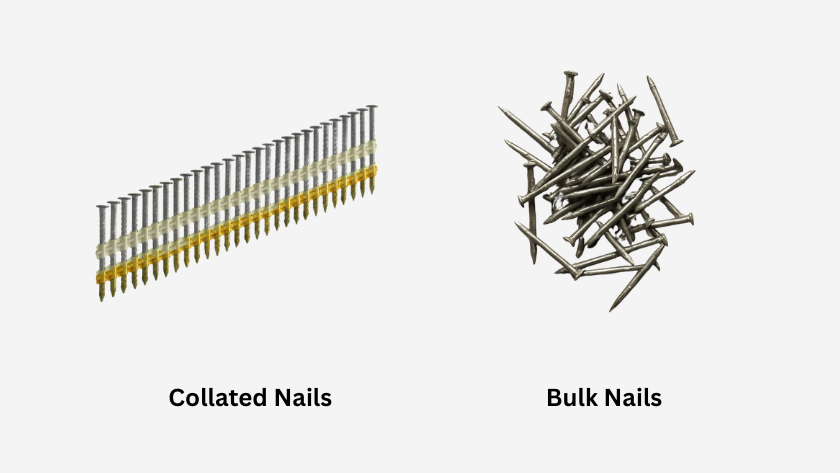
Selecting the appropriate nail is essential to ensure durability and efficiency during woodworking, construction, or other home improvement tasks. The most important decision is whether to utilize collated or bulk nails.
Each kind has its own advantages, optimal scenarios of use, and compatibility with other tools. In this tutorial, we’ll compare collated nails with bulk nails to aid you in determining which one will work best for your particular project.
What Are Collated Nails?
Definition
Collated nails are those held together in a strip sheet or coil with wire, plastic, or even paper. They have been specifically developed for use with nail guns, allowing for fast and effective attachment.
Types of Collation Methods
-
- Plastic Strip Collation It is held together with plastic strips and typically used to frame nailers.
-
- Wire Coil Collation Nails can be laid out in coils and connected with wire. It is commonly used for siding and roofing.
-
- Collation with Paper Paper keeps nails in place, minimizing the possibility of jamming and debris within nail guns.
Pros of Collated Nails
-
- Speedy Application: Accelerates considerably when compared with hand-driving nail bulk.
-
- Consistent nail Spacing ensures uniformity and minimizes the chance of human errors.
-
- Improved Holding Power Nail guns can drive collated nails with greater force, enhancing grip and penetration.
-
- Lower Physical Work: A hammer is not required, which reduces stress on wrists and hands.
Cons of Collated Nails
-
- It needs a nail Gun. It can’t be operated manually, making the initial investment more expensive.
-
- Limited Flexibility: The size and the type depend on the nail gun’s compatibility.
-
- Plastic or Paper Waste: A few collation techniques create waste that requires cleaning.
Best Uses for Collated Nails
-
- Construction and framing
-
- Siding and roofing
-
- Deck building
-
- Trim and moulding installation
-
- Fencing and outdoor projects
If you’re tackling a massive project that demands rapidity and speed, collated nails are the ideal choice.
What Are Bulk Nails?
Definition
The bulk nails are nails that are not in use and are offered in boxes, bags, or buckets. They can be driven by hand with a hammer, a specially designed pneumatic nailer, or a hand nailer.
Pros of Bulk Nails
-
- Flexible: Available in more sizes, shapes and material options that nail collated.
-
- It does not require any special tools: It can be controlled using a normal Hammer, making it easily accessible to newcomers.
-
- More affordable upfront: There is no need to purchase a nail gun to lower prices for smaller tasks.It is ideal for work with finer details.
-
- Best for Detail Work: It is ideal for work where a nail gun could be too powerful.
Cons of Bulk Nails
-
- A slower program: Manually nail driving takes longer and more energy.
-
- Greater Probability of Errors The placement of nails can be inconsistent without the accuracy of a nail gun.
-
- A greater physical exertion is needed: Using nails to hammer repeatedly could create fatigue in the hands.
Best Uses for Bulk Nails
-
- Small-scale woodworking projects
-
- Construction of furniture or repairs
-
- Crafting and decorative woodwork
-
- DIY home improvement tasks
-
- Projects in which the exact nail type is vital
If your work needs control, flexibility, and precision but does not require speed, large nails are the best choice.
Collated vs. Bulk Nails: Key Differences
| Feature | Collated Nails | Bulk Nails |
| Application Speed | Fast, automatic with a nail gun | Slower, manual hammering required |
| Tool Requirement | Needs a compatible nail gun | Can be used with any hammer |
| Holding Strength | Stronger due to consistent driving force | Depends on hammer technique |
| Precision & Placement | Uniform, consistent spacing | Requires skill for even placement |
| Project Size | Best for large-scale projects | Best for small, detailed work |
| Initial Cost | Higher (nail gun required) | Lower (no special tools needed) |
| Material Availability | Limited to nail gun-compatible sizes | Wide variety available |
Which One Should You Choose?
Choose Collated Nails If:
-
- It is a huge-scale framing or construction.
-
- It is essential to have speed and effectiveness to finish your work swiftly.
-
- Do you have a nail gun, or would you like to buy one?
-
- Your project requires consistent nail placement and strong holding power.
Examples of Ideal Projects:
-
- Building a house frame or deck
-
- The installation of roofing siding
-
- Fences that are fastened, as well as outdoor structures
Choose Bulk Nails If:
-
- It is a time to work with smaller-scale projects or make repairs.
-
- You value control and precision over speed.
-
- Don’t make the mistake of investing in a nail gun.
-
- It is necessary to have a greater variety of nail types to suit different uses.
Examples of Ideal Projects:
-
- Furniture repair and modular kitchen development
-
- Creative and decorative woodwork
-
- General home improvement tasks
Final Thoughts
The selection of collated or bulk nails is contingent upon the requirements of your project.
-
- Collated nails can be ideal for professional or large projects that need quick, efficient, and consistent positioning.
-
- Bulk nails are ideal for small, precise, or DIY projects in which flexibility and control are more important than speed.