


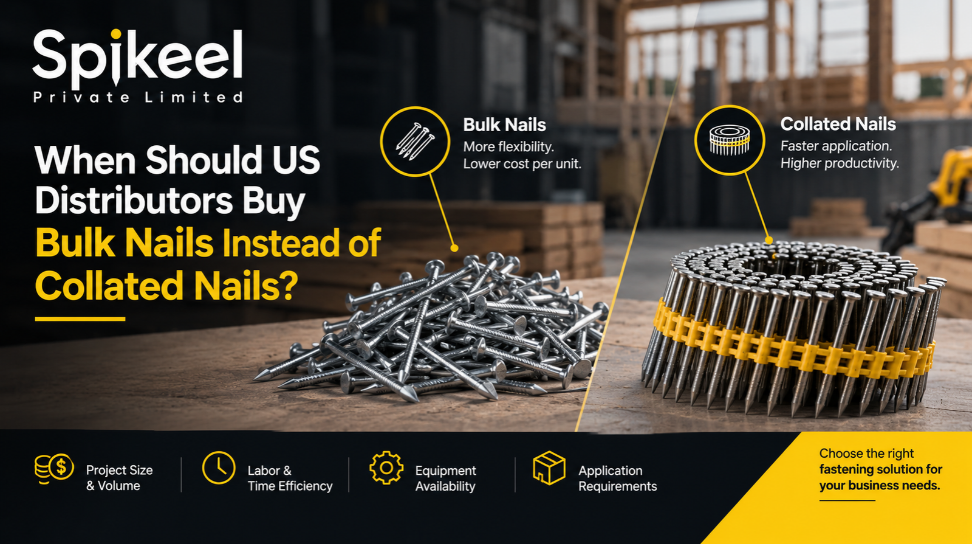
For fastener distributors, buying bulk nails instead of collated nails makes sense when customer demand, packaging requirements, and the intended application favor loose fasteners over nails assembled into strips or coils. Bulk nails can suit hand-nailing, certain industrial production processes, and customers who need flexible quantities or a broad selection of nail types.
Collated nails are often more practical for customers using compatible pneumatic nailers, particularly when repetitive fastening makes loading time and labor productivity important. The right purchasing decision depends on more than the price per nail: distributors must also consider packaging, handling, inventory turnover, customer requirements, and the total cost of supplying the product.
For businesses sourcing bulk nail supplies, the goal is to match the product format to actual demand while maintaining consistent specifications and commercially sensible stock levels.
1. What Is the Difference Between Bulk Nails and Collated Nails?
Bulk nails are supplied loose in packaging such as cartons, boxes, or drums. Collated nails are joined into strips or coils using materials such as plastic or wire, allowing them to feed through compatible nail guns.
Purchasing factor
Bulk nails
Collated nails
Product format
Loose, unassembled nails
Nails arranged in strips or coils
Typical use
Hand-nailing and compatible industrial processes
Repetitive fastening with compatible nailers
Tool requirements
Hammer or equipment specifically designed for loose nails
Compatible pneumatic or other designated nailer
Packaging considerations
Bulk quantity, carton weight, and handling
Collation integrity, coil or strip configuration, and tool compatibility
Inventory considerations
Useful for customers needing loose nails in specified sizes
Useful for customers who consume particular collated formats
Main cost considerations
Unit price, packaging, handling, and applicable labor
Nail price, collation, equipment, productivity, and downtime
Neither format is automatically more economical. The better option depends on how the customer uses the nails and the full cost of supplying and installing them.
2. When Should Distributors Choose Bulk Framing Nails?
Bulk framing nails may be appropriate when customers need loose nails for manual fastening, compatible automated equipment, or industrial operations that do not require collated strips or coils.
Consider bulk nail purchasing when:
Customers regularly order loose nails: Repeat demand for specified dimensions and nail types can support planned bulk purchasing.
The application uses manual fastening: Customers working with hammers or suitable hand tools may not need collated products.
Industrial equipment accepts loose nails: Some production processes use bulk-fed or specialized fastening equipment. Compatibility must be confirmed with the equipment manufacturer.
Customers need different nail configurations: A distributor may serve buyers requiring particular head styles, shank types, lengths, or finishes.
Packaging can be handled efficiently: Bulk cartons or drums may suit the customer’s receiving, storage, and material-handling arrangements.
For example, a woodworking or packaging operation may use loose nails for a defined production process. A distributor supplying that operation should confirm the required nail dimensions, material, and finish before selecting a bulk product.
However, loose nails are not a direct substitute for collated nails in every application. A customer using a pneumatic framing nailer may require a specific collation angle, nail geometry, and magazine configuration. In that situation, switching to bulk nails could disrupt the customer’s workflow rather than reduce costs.
3. When Are Collated Nails the Better Purchase?
Collated nails are generally more suitable when customers need a nailer-compatible product for repetitive fastening.
Examples include framing, roofing, decking, fencing, pallet production, and other applications where the appropriate collated nail and tool are specified.
Distributors should consider collated products when customers prioritize:
Faster repetitive fastening compared with manual hammering.
Reduced manual loading between fastening cycles.
Compatibility with an established pneumatic nailer fleet.
Consistent product presentation and feeding in the intended equipment.
A standardized fastener format for recurring production work.
For example, a pallet manufacturer using compatible pneumatic coil nailers may prefer wire-collated coil nails because the format supports repeated fastening with fewer manual reloading steps than loose nails.
The exact benefit depends on the equipment, operator, nail specification, and production process. Collation does not eliminate every jam or guarantee consistent fastening. Nail dimensions, collation quality, tool condition, and correct setup all matter.
Spikeel manufactures 15-degree wire-collated coil nails and 21-degree plastic-collated strip nails. Buyers should confirm the exact product specifications and compatibility requirements before ordering.
4. Compare Total Purchasing Cost, Not Just Price per Nail
A low bulk nail price does not automatically mean lower total cost. Distributors should compare the costs that arise from purchasing, storing, handling, and supplying the product.
A practical comparison includes:
Total supply cost = product purchase cost + packaging and handling + freight and applicable import charges + inventory costs + other order-related expenses.
For customers evaluating installation productivity, labor and equipment operating costs should also be considered.
Cost factor
Questions for distributors
Purchase price
Is the quotation based on the same dimensions, material, finish, and quantity?
Packaging
How many nails are supplied per carton, and what handling is required?
Freight and import costs
What charges apply to the agreed shipment and delivery terms?
Storage
Will the packaging fit existing storage and inventory procedures?
Handling labor
Does loose-nail handling create additional work for the customer?
Customer equipment
Does the application require collated nails and compatible nailers?
Inventory turnover
Can the distributor sell the planned quantity within a reasonable stock period?
A useful example is a distributor comparing loose nails with collated nails for a customer who already owns compatible nail guns. The bulk option may have an attractive purchase price, but if the customer must introduce different equipment or change its process, the apparent savings may disappear.
Conversely, a customer using loose nails in an established production process may gain little from paying for collation it does not need.
Request comparable quotations with the same specifications, packaging basis, order quantity, and commercial terms. That makes the comparison more meaningful.
5. Which Bulk Nail Supplies Should Distributors Stock?
Stock decisions should follow customer demand rather than an assumption that every nail type will sell equally well.
Before adding a bulk nail supply to inventory, review:
Dimensions: Nail length and diameter must match customer specifications.
Nail design: Confirm head style, point type, and smooth, ring, or screw shank requirements.
Material: Verify the specified steel or other material requirements.
Finish: Select bright, electro-galvanized, or hot-dip galvanized options only where appropriate and available.
Application: Understand whether the nails are intended for woodworking, packaging, construction, or another use.
Packaging: Establish carton or drum quantities, labeling, and handling requirements.
Demand pattern: Use sales history, customer forecasts, and repeat-order frequency to guide stock levels.
For outdoor or moisture-exposed applications, finish selection deserves particular attention. Electro-galvanized and hot-dip galvanized nails differ in coating characteristics and corrosion performance. Neither should be selected without considering exposure, substrate, project specifications, and any applicable code or manufacturer requirements.
For applications involving treated lumber, structural connections, or other demanding conditions, confirm the required fastener specification with the project documentation and qualified technical personnel.
Spikeel’s bulk nails product page provides information about its loose nail category. Specific dimensions, finishes, packaging, and order requirements should be confirmed directly before a purchasing commitment.
6. How Can Bulk Nails Distributors Manage Inventory Risk?
Bulk purchasing can improve procurement efficiency when demand is predictable, but excessive stock can tie up working capital and create storage challenges.
Use these practical controls:
Forecast demand: Review historical sales and confirmed customer requirements before committing to a large quantity.
Standardize specifications: Maintain clear product descriptions and item codes to prevent confusion between similar sizes or finishes.
Check packaging and storage: Protect inventory from moisture, damage, contamination, and identification loss.
Track stock movement: Monitor fast-moving and slow-moving products to guide replenishment decisions.
Review supplier consistency: Compare delivered products with approved specifications and inspection requirements.
Plan repeat orders: Discuss order quantities, production scheduling, and lead-time assumptions with the supplier rather than relying on unconfirmed availability.
For imported supplies, distributors should also account for freight, customs clearance, applicable duties, and the time needed to receive and inspect inventory. Actual costs and timelines depend on the shipment and its commercial arrangements.
A larger order is beneficial only when the savings and supply-planning advantages justify the inventory commitment.
7. What Should Buyers Check Before Selecting a Bulk Nail Supplier?
Price is only one part of supplier evaluation. Distributors should assess whether a manufacturer can supply the required product specification and provide appropriate quality documentation.
Ask prospective suppliers:
Which nail types, dimensions, and finishes can you supply?
What quality checks are performed on finished products?
How are batches identified and traceability records maintained?
What packaging and labeling options are available?
What order quantities and commercial terms apply?
Which inspection documents can be provided?
How are nonconforming products and quality claims handled?
Spikeel Pvt Ltd is a fastener manufacturer based in Bangalore, Karnataka, India. Its published product categories include bulk nails, 15-degree wire-collated coil nails, and 21-degree plastic-collated strip nails.
Buyers can review Spikeel’s manufacturing capabilities and quality assurance processes to understand its published manufacturing and inspection approach. Confirm the specific requirements of your order directly with the company.
Conclusion
US distributors should buy bulk nails instead of collated nails when loose fasteners match customer applications, handling processes, and inventory needs. Collated nails are generally the better fit when customers depend on compatible nailers and repetitive fastening workflows.
The best purchasing decision compares total cost, customer demand, product specifications, equipment compatibility, packaging, and inventory risk. It should also account for the requirements of the intended application rather than assuming that one format is universally better.
For distributors evaluating bulk nail supplies, reviewing the manufacturer’s product range, manufacturing capabilities, and quality processes is a practical next step before requesting a quotation.
Looking for a Bulk Nail Supply Partner?
Explore Spikeel’s bulk nails and review the available product information for your distribution requirements.
You can also explore our manufacturing capabilities or contact Spikeel to discuss nail specifications, order quantities, and purchasing requirements.
Request a Quote to discuss your bulk fastener needs.