


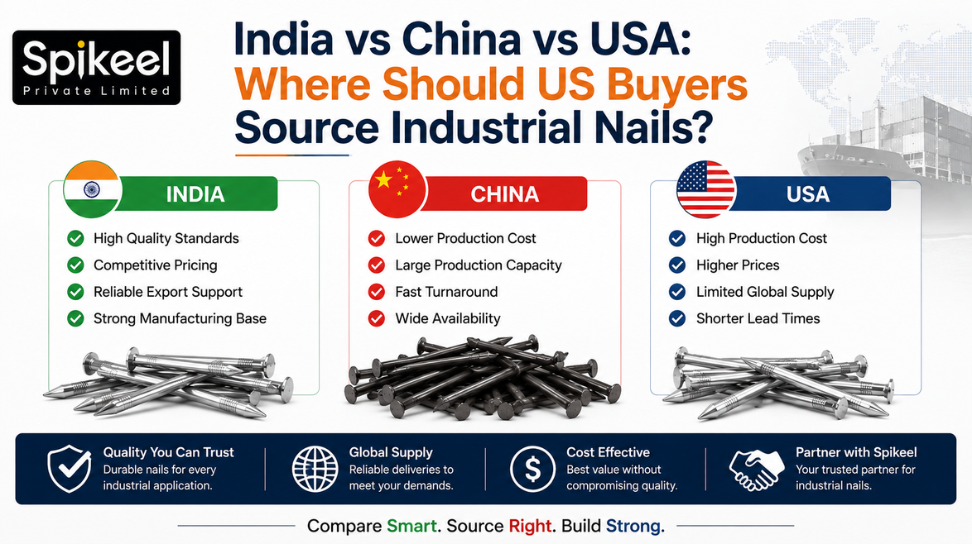
For US construction companies, distributors, wholesalers, manufacturers, and procurement teams, sourcing industrial nails is not simply about finding the lowest quoted price. The real decision involves product quality, manufacturing capability, landed cost, lead time, order volume, customization, packaging, and supply reliability.
US buyers commonly evaluate suppliers from domestic manufacturers as well as international manufacturing markets such as China and India. Each sourcing route has advantages and considerations.
So, where should US buyers source industrial nails?
The answer depends on the buyer’s business model, order volume, application, delivery expectations, and long-term sourcing strategy. For many businesses, comparing the complete supply chain, not just the unit price, is the most practical way to make the right decision.
SPIKEEL, based in Bangalore, Karnataka, India, manufactures industrial fasteners including 15-degree wire-collated coil nails, 21-degree plastic-collated strip nails, and bulk nails for construction, packaging, woodworking, and industrial applications. The company positions its products for US and international buyers.
India vs China vs USA: What Should Buyers Compare?
There is no universal answer to which country is the best sourcing location. A US buyer should compare suppliers across several factors:
- Product quality and consistency
- Manufacturing capability
- Total landed cost
- Minimum order quantities
- Production capacity
- Lead times
- Product customization
- Packaging and private labeling
- Quality assurance
- Communication
- Export experience
- Long-term supply reliability
Looking at these factors together provides a more accurate picture of the real cost and value of a supplier.
1. Sourcing Industrial Nails From the USA
Buying from a US-based manufacturer or distributor can be attractive when short lead times, domestic communication, and local inventory are the highest priorities.
For contractors or businesses that need immediate replenishment, domestic sourcing can simplify purchasing and reduce the complexity associated with international transportation.
A US-based source may also be convenient for buyers who purchase smaller quantities or require frequent deliveries.
However, larger-volume buyers should still compare the overall commercial proposition. Depending on the supplier and product, domestic sourcing may not always provide the most competitive option for high-volume procurement.
For example, a construction distributor purchasing large quantities of industrial nails may want to compare domestic inventory pricing against direct international manufacturing.
The important question is not simply:
“Is the supplier in the USA?”
Instead, ask:
“What are my total cost, delivery requirement, and supply risk?”
2. Sourcing Industrial Nails From China
China has a large and established manufacturing base across many industrial product categories, including fasteners.
For US buyers, China can offer access to a broad manufacturing ecosystem and suppliers capable of handling different product specifications and order volumes.
However, the right supplier still needs to be evaluated individually.
A buyer should investigate:
- Manufacturing facility
- Quality-control procedures
- Material specifications
- Product consistency
- Export experience
- Packaging standards
- Production capacity
- Communication
- Lead times
- Total landed cost
The country of manufacture alone does not determine whether a particular supplier is reliable.
A low initial quotation can also become less attractive when freight, duties, inspection, warehousing, quality issues, or other supply-chain costs are considered.
Therefore, US buyers should compare supplier-to-supplier, not simply country-to-country.
3. Sourcing Industrial Nails From India
India is another important manufacturing market for industrial products and engineered fasteners.
For US buyers, sourcing directly from an Indian manufacturer can provide an alternative to both domestic and other international sourcing channels.
SPIKEEL is an India-based manufacturer located in Bangalore, Karnataka, specializing in industrial nail fasteners. Its product range includes 15-degree wire-collated nails, 21-degree plastic-collated strip nails, and bulk nails.
The potential advantages of direct Indian manufacturing should be evaluated based on the individual supplier’s:
- Manufacturing capabilities
- Quality systems
- Product specifications
- Production capacity
- Export readiness
- Packaging options
- Customization capabilities
- Communication
- Order requirements
For distributors and industrial buyers, the ability to establish a direct relationship with the manufacturer can be particularly useful when planning repeat or high-volume purchases.
The Most Important Factor: Total Landed Cost
One of the biggest mistakes in international sourcing is comparing only the factory price.
For US buyers, the actual purchasing cost can be better understood through total landed cost.
This can include:
Product cost + packaging + freight + duties and applicable import costs + inspection + warehousing + handling + potential quality/replacement costs
For example, Supplier A may offer a lower factory price but have higher transportation or handling costs. Supplier B may have a slightly higher product price but offer better packaging, consistency, or logistics.
That is why procurement teams should compare complete quotations rather than focusing on one number.
A fastener supplier should be able to provide clear information about product specifications, packaging, order quantities, and commercial terms so buyers can make an informed comparison.
Quality Should Come Before Price
Industrial nails may look simple, but manufacturing consistency matters.
Variations in nail length, diameter, head formation, point quality, shank profile, coating, or collation can affect how a product performs in production or on a construction site.
For example, SPIKEEL’s 15-degree wire-collated coil nails are offered in different materials, finishes, shank profiles, and specifications for applications including framing, roofing, decking, sheathing, fencing, pallets, and packaging.
For bulk nails, buyers may also need different nail types, sizes, shank designs, and finishes depending on their application. SPIKEEL offers bulk nails in loose format for industrial and distribution use, with options including mild steel, electro-galvanized, and hot-dip galvanized finishes.
Before placing a large order, US buyers should request samples or technical specifications where appropriate and evaluate the product against their actual application.
What About Product Availability?
The best sourcing location also depends on how frequently you need the product.
A local US distributor may be useful when you need:
- Small quantities
- Fast replenishment
- Local stock
- Short delivery cycles
Direct manufacturing may become more attractive when you need:
- Larger quantities
- Regular purchasing
- Customized specifications
- Special packaging
- Private labeling
- Long-term supply planning
SPIKEEL states that it supports bulk orders, customized sizes and finishes, and private-label packaging for distributors and industrial customers.
This makes the direct-manufacturer model worth considering for US businesses that have predictable purchasing requirements.
Which Sourcing Model Is Best for Different US Buyers?
Construction Contractors
Contractors generally prioritize product compatibility, performance, availability, and delivery speed.
If a contractor needs immediate material for an active project, domestic inventory can be convenient. For recurring high-volume requirements, however, working with a dependable international manufacturer may also be worth evaluating.
Industrial Manufacturers
Manufacturers often have predictable consumption and can plan purchases in advance.
For these buyers, direct sourcing can provide opportunities to discuss specifications, packaging, quality requirements, and recurring supply.
Distributors and Wholesalers
Distributors need more than a product. They need a dependable supply partner.
An industrial nail distributor USA operation may need multiple sizes, finishes, packaging formats, and consistent replenishment.
This is where manufacturer relationships can become valuable. A distributor can evaluate whether an international supplier can support its product portfolio and future growth.
B2B Procurement Teams
Procurement professionals should compare suppliers using measurable criteria rather than assumptions about a country.
A practical supplier scorecard can include:
| Evaluation Factor | What to Check |
| Quality | Specifications, consistency, inspection |
| Price | Unit price and complete landed cost |
| Capacity | Ability to support forecasted volume |
| Lead Time | Production and shipping timelines |
| Packaging | Export, bulk and private-label options |
| Customization | Sizes, coatings, and specifications |
| Communication | Response time and technical support |
| Reliability | Repeat-order performance |
This approach helps buyers identify the best industrial nail supplier USA businesses can work with, not simply the cheapest quotation.
Bulk Industrial Nails: When Direct Manufacturing Makes Sense
For companies purchasing bulk industrial nails in the USA for construction, packaging, pallets, woodworking, fencing, or manufacturing, direct sourcing may be worth considering when order volumes are large enough to justify international procurement.
Bulk nails are particularly relevant for wholesalers, distributors, production facilities, and businesses that consume large quantities regularly.
SPIKEEL’s bulk nail range is designed for high-volume industrial and distribution use and includes different nail types, sizes, shank styles, and finishes.
Before selecting a supplier, buyers should discuss:
- Required nail specifications
- Monthly or annual demand
- Packaging requirements
- Order quantities
- Quality expectations
- Delivery schedule
- Labeling requirements
- Future volume forecasts
The goal is to build a supply arrangement that works beyond a single shipment.
India vs China vs USA: A Practical Decision
Rather than declaring one country the universal winner, US buyers should match the sourcing location to their priorities.
Choose a US supplier when:
You prioritize local availability, shorter delivery cycles, and domestic purchasing convenience.
Consider China when:
You are evaluating suppliers with established manufacturing capabilities and competitive commercial terms that meet your quality and supply requirements.
Consider India when:
You want to evaluate an alternative international manufacturing source with direct access to an Indian manufacturer, customization options, and potential for long-term B2B supply.
Ultimately, the best nail supplier for US buyers is the one that can consistently meet your specifications, quality expectations, order volumes, delivery requirements, and commercial targets.
Why US Buyers Should Evaluate SPIKEEL
SPIKEEL is an industrial fastener manufacturer based in Bangalore, Karnataka, India, with a focus on engineered nail products for construction and industrial applications. The company manufactures 15-degree wire-collated coil nails, 21-degree plastic-collated strip nails, and bulk nails.
For US buyers, SPIKEEL offers a direct manufacturer-to-business sourcing model rather than simply acting as a reseller.
Its product range includes mild steel, electro-galvanized, and hot-dip galvanized options, while the company also highlights customization, bulk supply, export packaging, and private-label support.
For a US distributor, wholesaler, contractor, or industrial procurement team, this means SPIKEEL can be evaluated based on the factors that matter most: product specifications, quality, volume capability, packaging, customization, and long-term supply requirements.
Questions US Buyers Should Ask Before Choosing a Supplier
Before placing a commercial order, ask every potential supplier the same basic questions:
- Where are the nails manufactured?
- What materials and finishes are available?
- What product specifications can you supply?
- What quality checks are performed?
- Can you provide product samples?
- What are your minimum order quantities?
- Can you handle recurring bulk orders?
- What packaging options are available?
- Can you support private-label requirements?
- What is the expected production and shipping timeline?
- How will product quality be maintained across repeat orders?
- Can you provide documentation relevant to the buyer’s requirements?
The answers will often tell you more about a supplier’s reliability than its advertised price.
Final Verdict: India, China or USA?
There is no single sourcing location that is best for every US buyer.
The USA can offer convenience and local availability. China provides a large manufacturing ecosystem that many buyers evaluate. India offers another direct-manufacturing option for companies looking for international sourcing alternatives.
For US buyers, the smartest approach is to compare quality, total landed cost, production capacity, lead time, customization, packaging, and supplier reliability before making the final decision.
If your business requires recurring volumes of construction or industrial nails, don’t select a supplier based on price alone. Request specifications, evaluate samples where appropriate, compare the complete commercial offer, and consider whether the manufacturer can support your business as demand grows.
For businesses looking for a reliable nail supplier USA buyers can evaluate from India, SPIKEEL provides an industrial nail manufacturing and supply option from its Bangalore, Karnataka facility.