


For US construction companies, distributors, wholesalers, and industrial buyers, choosing the right nail manufacturer is about much more than finding the lowest price. Fasteners are small components, but their consistency can directly affect installation speed, holding performance, product quality, and customer satisfaction.
This becomes even more important when sourcing nails internationally. A US buyer working with an overseas manufacturer needs confidence in product specifications, manufacturing capacity, quality control, packaging, communication, and supply reliability.
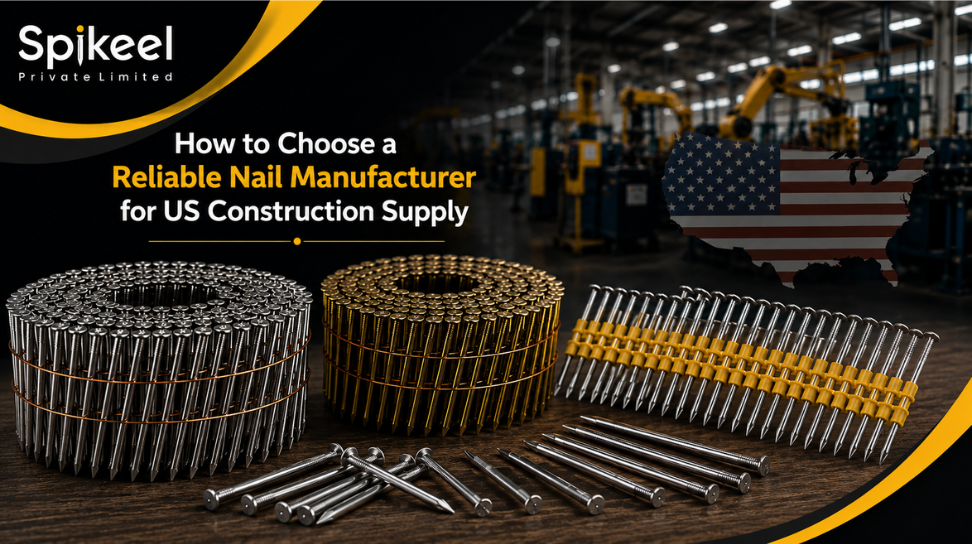
For businesses sourcing from India, SPIKEEL manufactures industrial nail fasteners in Bangalore, Karnataka, India, and supplies products for international markets including the United States. Its product range includes 15-degree wire-collated coil nails, 21-degree plastic-collated strip nails, and bulk nails.
So, how should a US buyer evaluate a nail manufacturer before placing an order?
1. Start With Manufacturing Capability
The first question should be simple: Does the manufacturer actually have the production capability to supply your requirements consistently?
A reliable fastener company should have appropriate manufacturing equipment, trained personnel, quality-control processes, and sufficient production capacity for the order volume.
This matters particularly for US distributors and B2B buyers. A supplier may be able to fulfill a small trial order but struggle when demand increases. Before choosing a manufacturer, ask about:
- Manufacturing location and facilities
- Production capacity
- Product range
- Available nail sizes and specifications
- Material options
- Surface finishes
- Quality-control procedures
- Packaging capabilities
- Export experience
- Ability to handle repeat orders
SPIKEEL’s manufacturing operations are based in Bangalore, India, with a focus on engineering nail fasteners and international markets. The company specializes in wire-collated and plastic-collated nail products.
2. Match the Manufacturer to Your Nail Application
A good manufacturer should not simply sell “construction nails.” It should offer products appropriate for different applications and tools.
For example, US construction and industrial buyers may require wire-collated coil nails for high-volume fastening, plastic-collated strip nails for framing applications, or loose nails for distribution and manufacturing.
15-Degree Wire-Collated Coil Nails
15 degree wire coil nails are designed for compatible pneumatic coil nailers and are commonly used in applications such as framing, roofing, decking, fencing, sheathing, pallets, and wooden packaging.
Their coil format allows a relatively high nail capacity, helping reduce reload frequency during repetitive work. SPIKEEL offers 15-degree wire-collated coil nails in different materials, shank types, lengths, and finishes.
For applications where corrosion resistance is important, buyers can consider 15 degree coil nails galvanized or stainless-steel options depending on the environment and application requirements.
SPIKEEL also lists 15 degree stainless steel coil nails for applications requiring enhanced corrosion resistance, including demanding outdoor or moisture-exposed environments.
21-Degree Plastic-Collated Strip Nails
21 degree plastic collated strip nails are another important category for construction and framing applications.
These nails are arranged on plastic strips and are designed for compatible framing nailers. They can be supplied in different lengths and coatings according to the buyer’s requirements.
A manufacturer should be able to clearly explain which nail specifications are suitable for the customer’s equipment and application rather than treating all collated nails as interchangeable.
SPIKEEL manufactures 21-degree plastic-collated strip nails as part of its industrial fastener range.
3. Check Material and Coating Options
Material selection is another important factor when comparing manufacturers.
A reliable nail manufacturer should provide clear information about the material and finish used for each product. Depending on the application, buyers may require mild steel, electro-galvanized, hot-dip galvanized, or stainless-steel nails.
For example, galvanized finishes can provide additional corrosion protection compared with plain steel, while stainless steel may be appropriate for applications where higher corrosion resistance is required.
The right choice depends on the installation environment, substrate, exposure conditions, and project requirements.
A manufacturer that clearly communicates these options makes it easier for contractors, distributors, and procurement teams to select the appropriate product.
4. Don’t Judge a Supplier Only by Price
Price is important in B2B purchasing, but the cheapest quotation is not necessarily the lowest-cost solution.
Consider the total cost of ownership instead.
A low-cost nail can become expensive if inconsistent dimensions cause feeding problems, poor collation increases downtime, coating performance is inadequate, or product quality varies between batches.
For US buyers, total sourcing cost may include:
- Product price
- Packaging
- International freight
- Import-related costs
- Warehousing
- Quality inspection
- Rejections or replacements
- Production downtime
- Inventory carrying costs
A dependable fastener supplier should therefore provide a balance of competitive pricing, consistent quality, production capacity, and dependable service.
5. Evaluate Quality Control Before Ordering
Quality control should be one of the most important parts of your supplier evaluation.
Before placing a large order, ask the manufacturer how it controls product consistency throughout manufacturing.
Important checkpoints can include:
- Nail dimensions
- Diameter and length
- Head formation
- Point quality
- Shank consistency
- Collation quality
- Coating or surface finish
- Packaging
- Batch consistency
For collated nails, collation quality is especially important because nails must feed correctly through compatible equipment.
SPIKEEL states that its products are manufactured with quality controls and are designed around consistent performance for construction, packaging, woodworking, and other industrial applications.
For a new supplier relationship, US buyers should also consider requesting samples and reviewing the product against their own application and equipment requirements before moving to a larger order.
6. Confirm Packaging and Export Readiness
International sourcing adds another layer to supplier selection.
A manufacturer supplying the US should understand that packaging is not simply about putting nails into a box. Packaging needs to protect the product during handling, transportation, storage, and distribution.
Ask the manufacturer about:
- Inner and outer packaging
- Product labeling
- Carton specifications
- Coil or strip protection
- Palletization
- Export packaging
- Private-label requirements
- Documentation
This is particularly important for distributors who will resell the products under their own brand or through established distribution channels.
SPIKEEL’s product information highlights export-oriented packaging and bulk supply for international buyers.
7. Consider Your Order Volume and Future Growth
A manufacturer should be capable of supporting you beyond the first purchase.
A US distributor might begin with a trial shipment and later require significantly larger quantities. Contractors and industrial customers may also need recurring supply throughout the year.
Before selecting a supplier, discuss:
Current requirement → trial order → repeat orders → forecasted demand → production capacity
This helps determine whether the manufacturer can become a long-term supply partner.
For businesses purchasing bulk nail products, production consistency and inventory planning become especially important. SPIKEEL supplies bulk nails in different types, sizes, and finishes for construction, manufacturing, distribution, and other industrial applications.
8. Choose the Right Product for Your Business Model
Not every buyer needs the same type of nail.
A contractor may primarily need collated nails compatible with specific nail guns. A distributor may need multiple sizes and finishes. A manufacturer may require large quantities of loose fasteners for production.
For example:
For construction contractors
Focus on tool compatibility, nail dimensions, coating, holding performance, and application.
For distributors
Focus on product range, packaging, consistency, pricing, lead times, and repeat-order capability.
For industrial manufacturers
Focus on specification control, production consistency, bulk availability, and supply continuity.
For wholesalers
Focus on competitive pricing, packaging, product variety, and dependable replenishment.
Understanding your own purchasing model helps you identify the right manufacturer rather than simply searching for the lowest quotation.
9. Look Beyond Individual Products
The best supplier relationship is usually built around a broader supply capability.
Instead of asking only:
“Can you supply this nail?”
US buyers should ask:
“Can you consistently supply this product specification as our demand grows?”
That difference is important.
A capable fastener manufacturer should be able to discuss product specifications, production capabilities, quality requirements, packaging, and delivery expectations with the buyer.
This is especially valuable for distributors and B2B procurement teams that need predictable supply rather than one-time purchasing.
10. Why US Buyers Can Consider an Indian Manufacturer
India has become an important manufacturing base for a wide range of industrial products, including steel and engineered fasteners.
For US buyers, working directly with an Indian manufacturer can provide access to manufacturing expertise, product customization, competitive sourcing, and international supply capabilities.
However, the decision should always be based on the manufacturer’s actual capabilities not simply the country where it is located.
For a US buyer evaluating an Indian nail manufacturer, look for:
- Verified manufacturing facilities
- Consistent product specifications
- Quality assurance processes
- Suitable material and coating options
- Export experience
- Transparent communication
- Scalable production
- Proper packaging
- Technical support
- Reliable long-term service
SPIKEEL is based in Bangalore, Karnataka, India, and specializes in industrial nail fasteners including 15-degree wire-collated nails and 21-degree plastic-collated strip nails. The company also supplies bulk nails for industrial and distribution applications.
What Should You Ask a Nail Manufacturer Before Ordering?
Before approving a new supplier, US buyers can use this simple checklist:
- Where are the nails manufactured?
- What materials and coatings are available?
- Which nail sizes and specifications can you produce?
- Are samples available for evaluation?
- What quality checks are performed?
- What packaging options are available?
- Can you support recurring bulk orders?
- Do you provide export-ready packaging?
- Can you support private-label or customized requirements?
- Can production scale with our future demand?
Getting clear answers to these questions can help prevent costly sourcing mistakes.
Why Choose SPIKEEL for US Nail Supply?
For US contractors, distributors, wholesalers, and industrial buyers, selecting a reliable manufacturer is an important part of maintaining consistent product quality and supply. SPIKEEL is a nail manufacturer based in Bangalore, Karnataka, India, serving international markets with engineered fastening solutions for construction and industrial applications.
Final Thoughts
Choosing a reliable nail manufacturer for US construction supply requires looking beyond price. Manufacturing capability, quality control, product consistency, material options, packaging, scalability, and communication all influence the success of a long-term supplier relationship.
For contractors, distributors, wholesalers, procurement teams, and industrial buyers, the ideal partner is one that understands both the technical requirements of fastening products and the practical demands of B2B supply.
SPIKEEL manufactures nail fasteners in Bangalore, Karnataka, India, with product solutions including 15-degree wire-collated coil nails, 21-degree plastic-collated strip nails, and bulk nails for construction and industrial applications. For US buyers, evaluating the manufacturer’s production capability, quality processes, specifications, and ability to support ongoing supply is the right starting point for building a dependable sourcing relationship.