


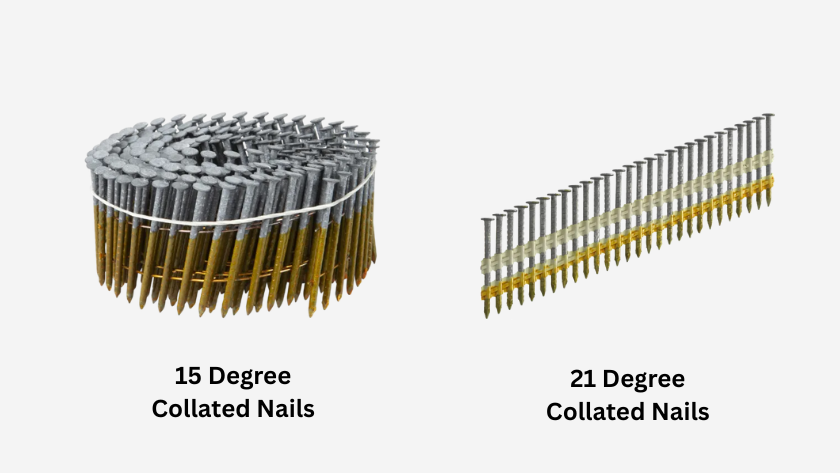
If you’re working in framing, construction, and woodworking, chances are you’ve come across angle-switch nail guns and collated nails. DIYers and builders’ most frequently asked question is distinguishing between 15 degree and 21 degree collated nails. Why does the angle of the nail play a role?
The angle of the nail plays a significant part in how nails will be driven, their hold strength, and their ability to work with the tool. Knowing the differences can aid you in selecting the best kind of nail to meet your needs while ensuring structural strength and efficiency.
In this post and guide, we’ll discuss the 15 degree and 21 degree collated nails. We’ll discuss their benefits, pros and cons, and the best way to choose the right one for your needs.
What Are Collated Nails?
Collated nails consist of nails held in coils or strips made to be inserted into nail guns for speedy and easy fixing. The nail angle is the strip’s angle concerning the weapon.
Two of the most commonly used nail angles for framing are the 15 degree and 21 degree which require a particular kind of nail gun. Angles differ in the way they affect:
-
- The method by which nails are held (wire coil instead of. strips of plastic)
-
- What is the maximum number of nails a gun can hold?
-
- Accessibility in cramped areas
-
- The total nail’s holding capacity is the same as that of a standard nail.
We’ll explore the various types more deeply.
Understanding 15 degree Collated Nails
What They Are
15-degree collated nails are available in coils, typically joined with a thin wire. This design permits nail guns to handle many nails simultaneously, reducing reload time.
Uses of 15 degree Collated Nails
-
- Framing in tight spaces
-
- Decking and roofing (where access and angles are essential)
-
- Subfloor and sheathing
-
- Heavy-duty applications in outdoor construction
Advantages of 15 degree Collated Nails
-
- Small coil style fits tight spaces and corners more effectively than strip nails.
-
- Higher nail capacity – Coil nailers hold more nails, reducing reload frequency.
-
- More adaptability for work with angles. It is excellent to frame difficult-to-reach locations.
-
- The process of collating wire creates less mess than plastic strip nails, which could break and create debris.
Disadvantages of 15 degree Collated Nails
-
- Nails that are bulkier gun Nailers with coils tend to be larger.
-
- The higher the starting cost, the higher the cost of coil nailers compared to strip nailers.
-
- Access is limited. It is not widely used for general framing, as nails with a 21-degree angle.
Understanding 21 degree Collated Nails
What They Are
21-degree collated nails are placed on a plastic strip at a slightly angled angle. They were widely utilized in previous framing nailers and are accessible for general use in construction.
Uses of 21 degree Collated Nails
-
- Framing standard software
-
- Walls, floors and roofing framing
-
- Fences and decking
-
- Wood-to-wood connections in general carpentry
Advantages of 21 degree Collated Nails
-
- More secure nail connections: The plastic collation can hold nails with precisely spaced spacing to provide a safe drive.
-
- It is more readily available and easier to get in hardware stores with nails larger than 15 degrees.
-
- Using nail guns is lighter and more comfortable, and 21-degree nailers are generally more stable.
-
- Perfect for structural framing, it meets construction code specifications for various regions.
Disadvantages of 21 degree Collated Nails
-
- Lower capacities for nails – holds smaller nails than coil nailers, which require more excellent refills.
-
- A lot more plastic trash – The plastic strips split in use, leaving behind debris.
-
- A larger nail gun is more difficult to use within tighter areas than 15-degree coil nailers.
Key Differences: 15° vs. 21° Collated Nails
| Feature | 15° Collated Nails | 21° Collated Nails |
|---|---|---|
| Availability | Less Common | Widely Available |
| Cost of Nail Gun | Higher | Lower |
| Collation Type | Wire Coil | Plastic Strip |
| Nail Capacity | Holds More Nails | Holds Fewer Nails |
| Ease of Reloading | Reloads Less Often | More Frequent Reloads |
| Nail Gun Size | Bulkier | More Balanced |
Which Nail Type Should You Choose?
Choose 15 degree Collated Nails If:
-
- You need a high nail capacity for fewer reloads.
-
- It’s a tight space where a small coil nailer will work better.
-
- Its roof or decking in which maneuverability is essential.
-
- You’re after lower trash made of plastic generated by nail collation.
Choose 21 degree Collated Nails If:
-
- You need nails for general framing and construction work.
-
- You prefer a lighter, easier-to-handle nail gun.
-
- You’ll need easily accessible nails and tools in most hardware shops.
-
- You’re working on structural framing, decks, and wood-to-wood applications.
Final Thoughts
The choice among 15 degree or 21 degree collated nail guns will depend on the nature of your project, the accessibility requirements, and the amount of time you’ll need to refill the nail gun.
-
- 15-degree nails work well in small spaces, roofing, and sheathing. They come in a coil shape that better holds the nails.
-
- 21-degree nails are great for general framing or construction, and they come in a wide range of options and have well-balanced nail guns.
Knowing the distinctions between these collated nail types ensures you select the best device for your task at hand, increasing its efficiency, durability, and ease of use.
If you now understand the importance of nail angle, what kind of nail will you pick to tackle your next task? Tell us in the comment section!